Generative AI is challenging higher education to reconsider what assessment actually measures. If students can generate essays, reports, and reflections within seconds, then traditional assessment formats risk becoming increasingly disconnected from authentic learning. At the same time, approaches focused primarily on AI detection and surveillance can undermine trust and shift attention away from the learning process itself.
At Inholland University of Applied Sciences, we have developed an alternative approach to assessment. It focuses less on policing AI use and more on making learning visible through iterative, media-rich, and reflective processes.
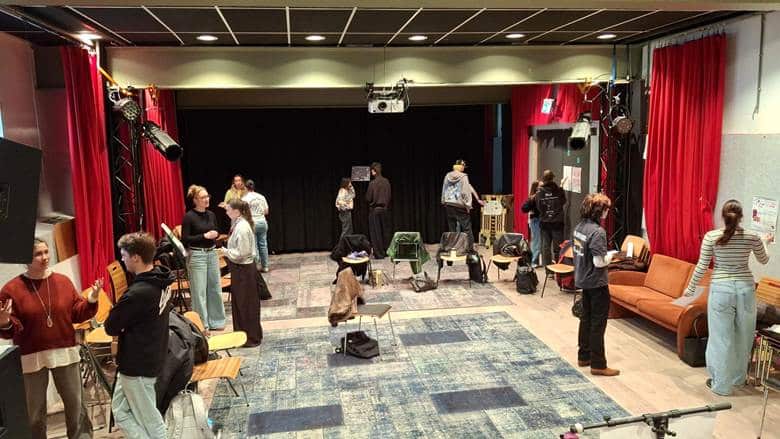
The 30 EC course takes place at two living labs: The International Music Industry Lab (Haarlem) and the Urban Leisure and Tourism Lab (Amsterdam). During 20 weeks, students collaborate in interdisciplinary teams on real-world societal challenges, in direct contact with external stakeholders. The labs are open, co-creative learning environments. Students engage with complex “wicked problems” that do not have simple or fixed solutions. The lab context requires students to navigate uncertainty, collaboration, communication, and reflection from the context of their own disciplinary knowledge.
As the assessment model has evolved, it became increasingly clear that evaluating only the final product was insufficient. The emphasis has shifted toward documenting and supporting the learning journey itself.
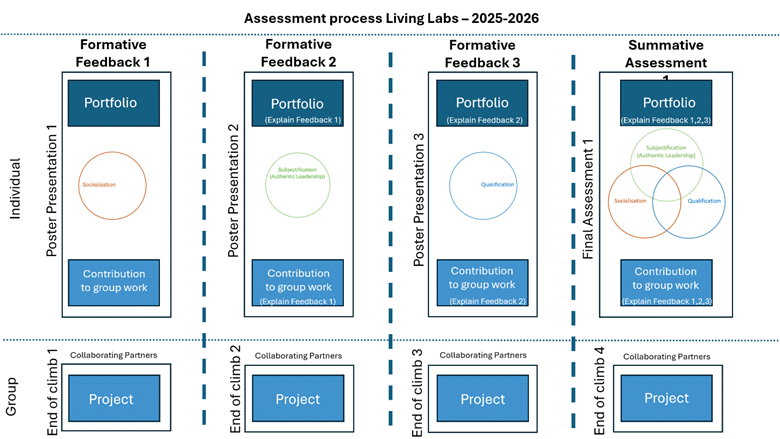
The assessment is based on Biesta’s three formats of education: qualification, socialization, and subjectification. Assessment is not solely a mechanism for measuring outcomes. The framework attempts to balance knowledge and skills development with professional identity formation, collaboration, and authentic leadership.
The Personal Roadmap is central to this process. Students document and account for their progress throughout the semester while reflecting weekly on prompts from the LMS. These reflections are supported through three formative and one summative “end of climb” presentations spread across the semester.
The presentations are intentionally iterative rather than high stakes. Students use A3 poster presentations, short pitches, prototypes, and reflective discussions to account for their progress. Peer and expert feedback are collected digitally and shared collectively with the whole group. Students need to be accountable for their learning, since they are communicating this to their peers. This creates transparency and trust within the learning community.